Pages

Saturday, March 30, 2019

Uganda's Lost Generation


Uganda's Lost Generation


Homelessness in San Francisco is one of the most pressing issues in the area. Multiply San Francisco’s homelessness problem by 1000 and envision the streets filled with children. Welcome to Uganda, where abandoned children wander the streets of major cities and villages. For years now, children in Uganda have faced the heartbreaking quandary of neglection.

Half of Uganda’s population is under 15 years old (“Uganda: Homeless”). Children and young adults are the largest and most vulnerable demographic group in the streets of Uganda (“Uganda: Homeless”). How did these children end up neglected, away from their families, and on the streets? The significant factor is the spread of the incurable HIV across the country. The HIV epidemic removed an entire generation of caregivers in Uganda and lead to millions of children orphans who now live in extreme poverty. There are many shortcomings in the infrastructure which is needed to help this neglected population (Ministry). As a result, access to basic services and rights is a lifelong problem for most orphan children (Ministry).

One of the root causes of neglect and abuse is due to the absence of adequate governmental protection. Around 2.5 million children are living in orphanages in Uganda (Hayden). However, an estimated 90% of the orphanages operate without official licenses, meaning that they are not subject to the child protection policies proposed by the government (Hayden). Often times the orphanages take advantage of the children by exploiting them as props for fundraising instead of providing constructive support (Nianias). Additionally, about 36% of children in Uganda are forced into labor to support their elderly family members (Hayden). Child labor and exploitation stunt the overall development of many children by taking away the opportunity for secondary education. With minimal enforcement of child protection laws, officials and police are complicit in the abusive system and make children fearfully veer away from asking adults for help. It is difficult for the children to defend themselves against a system that harshly blames them for petty crimes they may not even have committed.

Being deprived of a childhood and living alone in poverty has consequences on children’s later adult lives (Ministry). Poverty persists to the next generation and when former orphans start their own families, their children face a bleak future as well (Ministry). Ongoing family poverty deprives future generations of their fundamental rights and physical and psychological development (Ministry). Another long term effect of abuse and poverty is poor mental health and lifelong trauma (“Uganda: Homeless”). Children who experience any sort of abuse early on in their lives are 10 times more likely to engage in criminal behavior and abuse others as well (Nianias). Moreover, children who begin their lives at an orphanage face suicide rates 500 times higher than their counterparts (Nianias).

Although children still face frequent roundups, arrests, and targeted corruption, many nonprofit organizations have begun considering beneficial changes for Uganda. The Human Rights Watch is pushing the Ugandan government to implement a new child protection system that grants street children the same legal and physical protection as their Ugandan counterparts (“Where Do You Want Us to Go?”). Amongst these rights are access to primary education and shelter guidance. However, many nonprofit organizations are barred from operating in Uganda, leaving street children to fend for themselves (Riley). For now, major changes to the streets of Uganda remain put on hold.


Works Cited:


Hayden, Sally. "UGANDA: ORPHANS IN LIMBO." New Internationalist, Sept. 2018, p. 8+. Global Issues in Context, http://link.galegroup.com/apps/doc/A551963769/GIC u=los42754&sid=GIC&xid=47f795b9. Accessed 26 Mar. 2019.

Ministry Uganda, and Unicef Uganda. “Situation Analysis of Children in Uganda.” UNICEF, 2015, www.unicef.org/uganda/UNICEF_SitAn_7_2015_(Full_report).pdf.

Nianias, Helen. “No Hugs, No One to Talk to: How Ugandan Orphanages Are Harming a Generation | Helen Nianias.” The Guardian, Guardian News and Media, 23 Nov. 2017, www.theguardian.com/working-in-development/2017/nov/23/ugandan-orphanages-harming-a-generation.

Riley, Mark. “Volunteers Are Fueling the Growth of Orphanages in Uganda. They Need to Stop.” The Guardian, Guardian News and Media, 16 May 2016.

“Uganda: Homeless Children Face Violence, Exploitation.” Human Rights Watch, 23 June 2015, www.hrw.org/news/2014/07/16/uganda-homeless-children-face-violence-exploitation.

“‘Where Do You Want Us to Go?’ | Abuses against Street Children in Uganda.” Human Rights Watch, 16 June 2015, www.hrw.org/report/2014/07/17/where-do-you-want-us-go/abuses-against-street-children-uganda#.


Friday, March 29, 2019

Swaziland: Africa's Last Absolute Monarchy

Africa’s last absolute monarchy. A standard Swaziland has been upholding since the British colonization. A country so small one could not locate it in the middle of such a rich nation like South Africa. A king and his 14 spouses, more than 80 children, 13 palaces, a private jet, and multiple luxury cars control one of the poorest countries on Earth, with more than one-third of the population affected by HIV, unemployment, and famine (Robinson). Swaziland is leading a political, social and economical crisis, and is the situation in this country is considered by the rest of the world to be out of control.

 A strong issue persisting with the kingdom of Eswatini (Swaziland’s official new name) is a type of lifestyle and government that goes back to a “Middle Ages” type of era, with monarchies and disease. First of all, they are South Africa’s Last Monarchy, as mentioned before, which means the king holds total power over the country. His authority is so undeniable that he managed to take down three public schools to build his three palaces (Norman). Second of all, the HIV and tuberculosis rate in Swaziland is extremely high, the highest in the world (Jackson). These diseases have been proven to be terrifyingly lethal and that one out of four people carry it in Swaziland (Sander). This high disease rate is influenced by how badly the country’s economy is separated. Mswati III, the king of Swaziland, does not uphold the values of sharing, because the constitution was ignored and his actions regarding HIV were minimal (Jackson).

Another problem with Swaziland is the lack of democracy and the heavily unbalanced social class statuses. Supportives of the Swazi government are persuaded that the issue with HIV, poverty, and economy will not be solved by just switching to a democracy. “Revolutionaries” in Swaziland believe the exact opposite and want to join in a democracy like their South African neighbors (Robinson). The social standards in Swaziland are very sexist and homophobic. In fact, the Swatini government doesn’t prevent discrimination on the grounds of sex, language, sexual orientation, and gender identity. Married women are allowed minimal financial rights, but that is at far as it goes (Vicky). The male still has to be the “head of the house”, bringing food and money to the family and holding supreme authority on them, while the women’s role was mostly domestic. The issue is constantly being hidden by the king, and the government still hasn’t passed their law which punishes marital rape (Jackson). This highly benefits Mswati III, who is guilty of many moral offenses, such as marrying minors, etc… Another issue is the lack of freedom of speech. In order to get his dictatorship going, Mswati III highly censors the kingdom and is very careful about the image of his country. If any civilian were to insult or criticize the king in any way shape or form, it would be considered a “terrorist” act and perpetrator will be thrown to jail (Sander). All of these motives and reasons are factors for the instability of politics in Swaziland, mainly because of the king and his choices.

In conclusion, Mswati III ensures his absolute regime through keeping the country uncultured, using his notoriety to commit assaults on women, lets his country dies of disease or famine, ignores his own constitution, keep sexism and homophobia recurrent and censors freedom of speech. Africa’s last monarchy is in the midst of a desolate period, with thousands and thousands of men, women, and children dying every year and even more are suffering from poverty, disease and famine. 
Résultats de recherche d'images pour « swaziland »

Works Cited

 _Norman, Joshua. “The World's Enduring Dictators: Mswati III, Swaziland.” CBS News, CBS Interactive, 20 June 2011, www.cbsnews.com/news/the-worlds-enduring-dictators-mswati-iii-swaziland-19-06-2011/.

Sander, Philippe. “Swaziland: Africa's Last Absolute Monarchy | DW | 14.07.2014.” DW.COM, www.dw.com/en/swaziland-africas-last-absolute-monarchy/a-17784664.

Robinson, Amy. “Poverty and Hunger in Swaziland.” The Borgen Project, 11 Dec. 2017, borgenproject.org/poverty-hunger-swaziland/. 

Jackson, Lucas. “World Report 2018: Rights Trends in Swaziland.” Human Rights Watch, 18 Jan. 2018, www.hrw.org/world-report/2018/country-chapters/swaziland. 

BBC, Staff. “ESwatini Country Profile.” BBC News, BBC, 3 Sept. 2018, www.bbc.com/news/world-africa-14095303.

Vicky, Alain. “Africa's Last Absolute Monarchy.” Le Monde Diplomatique, 1 Oct. 2018, mondediplo.com/2018/10/10swaziland. 

Piracy Off the Somali Coast

Piracy Off the Somali Coast


Image result for somali pirates


For most of us, the phrase “maritime piracy” conjures up images of gritty accents, eyepatches, peg-legs, and cannons. These days, a half dozen former-fishermen with AK-47s and a speedboat fit the bill just as well. Piracy is ancient, but was exasperated in 1991 after the collapse of the Siad Barre regime and disbanding of the Somali navy lead to an inability to police the seas. The spike in illegal activity out at see pushed many fishermen to become pirates in order to stay profitable (Somalia). Pirates will try to board merchant vessels and oil tankers and run then aground, then hold the crew and cargo hostage for millions of dollars. Since 1960, piracy has resulted in a combined loss of over 100 billion dollars of oil, which also jeopardizes the safety of shipping routes. A country like Benin relies on import and export tariffs for 80% of its income, and compromised shipping routes meant a loss of 23% of the entire governmental budget. A dip in business also means less competition which jacks up the prices for locals, sometimes beyond what they can afford (Ben-Ari). Waning governmental budget also means a reduced ability to respond to piracy, which further deteriorates the economy. As a result, maritime piracy becomes primarily an economic issue. 

It’s easy to dismiss pirates as parasites of the ocean, but often they feel like Somalis are the ones wronged in the first place; one former fishermen describes how foreign fishing trawlers are stealing the natural resources of Somali Coast, without regard for local fishing. He describes how a foreign trawler drove over his nets and cut them, destroying his fishing equipment and with it, sabotaging his livelihood, forcing him into piracy. He plans to go back to fishing eventually but admits the attractiveness of the lucrative hauls (Somalia). Piracy can create an unnatural influx of cash and drive prices to a premium, that regular locals can’t afford. The ineffective Somali economy doesn’t provide an opportunity for advancement either. Piracy is seen as a relatively secure job, the type of job that kids grow up wanting to do (Bengali). 

In 2008, the UN finally approved for foreign powers to send warships into high risk areas to curb piracy. EU ships are somewhat effective at curbing piracy, as the 54 attacks in 2017 are significantly lower than 2011’s peak 250+ attacks, but even this moderate efficacy is being called into question. From 2015 to 2017, the piracy rate increased by a factor of three. EUNavfor rear admiral suspects the trend could continue to increase, “Piracy has been contained, but I really think the intention of going back to this business is still there” (Somalia). There is also significant sentiment from locals that the foreign intervention is not addressing the illegal foreign fishermen, and that foreign powers are purely acting on the interests of major corporations to preserve shipping routes (Harding). The future of the Somali Coast and its vast economic sphere is almost entirely dependent on how piracy is addressed. 


Works Cited:

Ben-Ari, Nirit. “Piracy in West Africa | Africa Renewal.” United Nations, United Nations, Dec. 2013, www.un.org/africarenewal/magazine/december-2013/piracy-west-africa. 
This article is mainly focused on the effects of piracy, and the scope of its impact. Piracy jeopardizes the security of shipping routes which harm economic activity in the area. This leads to less import export, less government income from taxes, which in turn leads back to less money and ability to enforce, allowing for more maritime crime. Foreign involvement in policing the waters is an expensive commitment, but may be the only solution to maintain current shipping routes. Africa Renewal is an organization within the UN devoted to improving global communications. This makes it a fairly reliable source, but may be somewhat biased in this case because the UN is an active participant in the controversy. 
Bengali, Shashank. “What's It like to Be a Pirate? In Dirt-Poor Somalia, Pretty Good.” Mcclatchydc, McClatchy Washington Bureau, 18 Dec. 2008, 1:10 pm, www.mcclatchydc.com/news/nation-world/world/article24516835.html.
This gives me a broad background on Somali piracy, their role in society, and how they were partially spawned by an economic recession. The Somali government and economy are in shambles, and unable to support industry. As a result many young men become pirates. Being a pirate seems to be a pretty sought after and desirable job. The influx of cash inflates the markets of coastal towns and drives up prices; this is good for business but bad for locals. McClatchy is a well known publishing source that has won multiple Pulitzer Prizes. The article does not talk about the impact on the ships pirated which seems pretty important. It was published over 10 years ago which is also not a good sign. 

The Guardian. “Somali Pirates Release Oil Tanker and Crew after First Hijack for Five Years.” The Guardian, Guardian News and Media, 16 Mar. 2017, www.theguardian.com/world/2017/mar/16/somali-pirates-release-oil-tanker-and-crew-after-first-hijack-for-five-years.
The article is somewhat useful when describing the viewpoints and motivations of the pirates. It does leave some room for interpretation and is not really conclusive. The Guardian is a reliable, well known source. The article mentioned multiple viewpoints and interpretations of events in an impartial manner and backed them up in historical context. In March of 2017 a ship was hijacked and held for ransom, the first hijacking of a large ship since 2012. The ship was eventually released without ransom after the pirates found out the ship was Somali. 

Harding, Andrew. “Somalia Warns of Return to Piracy.” BBC News, BBC, 31 Aug. 2015, www.bbc.com/news/world-africa-33822635.
This article discusses the motivations of the pirates, as well as some of the inadequacies in current solutions despite the fact that they decrease the piracy rates. BBC is a well known news source. The article presents multiple sides thoroughly. 2015 is also fairly recent. The author has also visited Somali coastal towns and written multiple articles about piracy. Resentment towards foreign fishing trawlers for stealing Somali resources is one important cause of piracy. Many regular fishermen become pirates. In 1998 Puntland declared itself autonomous within Somalia and since then political tensions have made any enforcement of anything very difficult. Some foreign intervention is effective at curbing piracy, but locals see this as just to protect the shipping routes and stopping the illegal fishers who are the real thieves. 

Ben-Ari, Nirit. “Piracy in West Africa | Africa Renewal.” United Nations, United Nations, Dec. 2013, www.un.org/africarenewal/magazine/december-2013/piracy-west-africa.
This article is mainly focused on the effects of piracy, and the scope of its impact. Africa Renewal is an organization within the UN devoted to improving global communications. This makes it a fairly reliable source, but may be somewhat biased in this case because the UN is an active participant in the controversy. Piracy jeopardizes the security of shipping routes which harm economic activity in the area. This leads to less import export, less government income from taxes, which in turn leads back to less money and ability to enforce, allowing for more maritime crime. Foreign involvement in policing the waters is an expensive commitment, but may be the only solution to maintain current shipping routes. 

“Piracy and Armed Robbery Against Ships in East Africa | SOP 2016.” OBP, 23 May 2018, oceansbeyondpiracy.org/reports/sop/east-africa.
This source had a lot of statistics that are useful in backing up arguments and giving an accurate depiction of the full situation. Oceans Beyond Piracy is a non-profit organization that seeks to reduce maritime violence. They have panels of experts in the field that release well established reports every couple of years. It is also very recent (2017) and shows that the decline in piracy in 2015 was short lived. The source is full of statistics that give an overview of piracy in East Africa in 2017. It is important to realize that many pirate attacks go unreported which will affect the accuracy of figures. 

Why Africa's Richest Countries are Also its Poorest

Why Africa's Richest Countries are Also its Poorest
Peter Budko

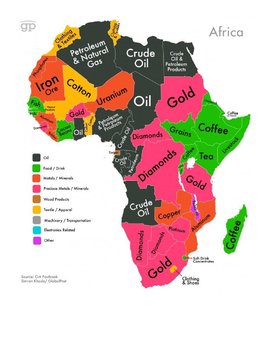
Equatorial Guinea is one of Africa’s richest countries, hosting a GDP per capita of 33,000 dollars, similar to that of the Western-European nation of Portugal. Equatorial Guinea is one of Africa’s poorest countries, where one fifth of all children die before the age of five and over half of all people don’t have regular access to clean water (Bekele). Equatorial Guinea is Africa’s greatest example of greed, corruption, and authoritarianism, problems which all stem from the country’s vast oil reserves. Natural resources have a proven correlation to authoritarianism (Wantchekon) and with authoritarianism comes poverty and corruption. For Africa, which has ⅓ of the World’s mineral wealth and 1/10 of its oil, the so called resource curse is a death sentence.
The first step in building an authoritarian government is being able to hold onto onto power without necessarily having the support of the general population. As long as a government has control over the revenue of a country’s resources, it can achieve this goal (Wantchekon). Creating such a situation is exceedingly easy in Africa, where countries like Angola and Niger rely on oil for over 90% of their exports. This means that African states experience a constant siphoning of money away from legitimate government projects into the pockets of authoritarian politicians. Because these types of governments are no longer reliant on the people and their taxes to stay in power, they can abuse their positions with impunity, leading to record levels of corruption (Tutton).
In 2002, 22.5 billion dollars in foreign aid was given to Africa by developed nations. In the same year, the African Union estimates that over 150 billion dollars were lost to corruption (Hanson). The prevalence of resource fueled authoritarianism in Africa means that high ranking government officials can simply take public funds for themselves. Funds destined to go to the improvement of infrastructure, education, and medical care simply don’t reach their intended destinations. Even those funds that are not outright stolen are often used to prop up the ruling government through military spending, election rigging, surveillance, and censorship (Wantchekon). Democratic institutions are rendered weak and helpless, and so they are (rightly) not viewed as an effective means for change. This encourages violence as an outlet for dissatisfaction, and exacerbates Africa’s already chronic problems with ethnic conflict. Take for example, Niger, which has been fighting separatist insurgents in the Niger Delta since 2004. The insurgents demand that the oil revenue from their region go back to them rather into the hands of the government (Hanson). The deadly combination of corruption and conflict proves fatal to young, developing economies like those found in Africa.
The paradox of poverty and natural resources is spawned from authoritarianism. When a government does not need the consent of its governed to remain in power, it has no incentive to try and work for their betterment. This situation can only be resolved by a fundamental shift from corruption to transparency, and from resource dependence to economic diversity. Though the rate of improvement for most of Africa is slow, countries like Ghana and Botswana have managed to create strong democracies and diverse economies to escape from the clutches of the resource curse (Wantchekon).

Related image
Image Source: https://www.teacherspayteachers.com/Product/Africa-Resource-Mapping-Activity-3902334

Works Cited:
1. Bekele, Daniel. “Africa's Natural Resources: From Curse to a Blessing.” Human Rights Watch, 2 Jan. 2019, www.hrw.org/news/2017/04/21/africas-natural-resources-curse-blessing.


This is an article about possible solutions to the problems caused by resource corruption. It first explains the issues with resource corruption, also adding to the other articles that mining/drilling corporations get favorable treatment from the government in relation to the people b/c the companies are where the power and money comes from. This results in a lack of care for the environment and also entire communities being kicked off their land without any warning. HRW is a reliable source on human rights abuses, but can often over exaggerate, so there might be some bias in that regard.

2. Wantchekon, Leonard. “Why Do Resource Abundant Countries Have Authoritarian Governments? .” Princeton.edu, Princeton University, 15 Oct. 2002, www.princeton.edu/~lwantche/Why_Do_Resource_Dependent_Countries_Have_Authoritarian_Governments.


This is an academic dissertation on the connection between resource dependency and authoritarian governance, mostly concerning African countries, but also using examples outside of Africa to support the overall argument. A statistical connection between these two things is found and explained with the ideas presented in the articles, albeit in more detail and with more supporting evidence. The article comes from princeton university and cites numerous sources. The author’s credibility and biases are unknown, and he could be writing this article in favor of his personal theory rather than the truth.

3. Tutton, Mark. “Can Africa Break Its 'Resource Curse'?” CNN, Cable News Network, 23 Aug. 2010, www.cnn.com/2010/WORLD/africa/08/23/africa.resource.curse/index.html.

This article explains the economics behind the ‘resource curse’, or why resource rich countries in africa have slower economic growth than average. Giving specific examples, it talks about how resources enable corruption and conflict, both of which create poverty by wasting public money. CNN, the publisher of this article may be considered biased in western politics, but there is no evident bias in Africa. The author is experienced with writing on Africa and corruption.


4. Hanson, Stephanie. “Corruption in Sub-Saharan Africa.” Council on Foreign Relations, Council on Foreign Relations, 6 Aug. 2009, www.cfr.org/backgrounder/corruption-sub-saharan-africa.


An overview of corruption in sub Saharan Africa by an organization experienced in covering similar topics. It gives a e good overview of the sources (authoritarianism) and consequences of corruption (poverty).  It gives examples of how corruption causes conflict in the competition for political power and how it funnels money out of the legitimate economy. There is no reason to believe that this source is biased, outside of a harsher than reality criticism of corruption, which doesn’t seem to be present.


የአንድ ዶላር አንድ ዶላር(A Dollar for A Dollar): The Impact of Foreign Investment in Ethiopia


Ethiopia is known for being one of the poorest nations in the world, one where people often are found without access to clean water and 700,000 people starving(Solomon). With all of these shortcomings, Ethiopia is growing at an unprecedented level, in part, due to the significant amount of foreign investment in the Eastern African nation. Starting in 2004, many countries found Ethiopia to be a prime site to invest in due to the nations geography, untapped market, and size(Smith). As the years went on, countries such as China started investing more in Ethiopia, causing annual economic growth.  

During some years, such as 2017, new forms of investment, such as the creation of factories and occupations, arose(Covernews). These new foreign implementations have caused the economy to thrive, prompting the nation to grow to become the fastest growing African nation(Cowen). Since being backed by countries such as China and the US, Ethiopia has been able to sustain a surprising 8.2% growth rate, making it not only the fastest growing African nation but also the fastest growing economy in the world(Cowen).

With the immense amount of foreign investment in Ethiopia, the infrastructure of the nation has significantly improved, through the creation of new buildings, roads, and railways(Marsh). These modifications offer significant changes as since previously Ethiopia has had a numerous sum of rundown buildings, undrivable roads, and many more problematic issues. Investments have changed this and with over 5 billion dollars invested to address all of these flaws(Marsh). Hence, the hefty investment money was used in the creation of new structures and establishments.

Although these financings have boosted Ethiopia as a nation, many are skeptical of the true intentions of these foreign nations. These practices have been associated with neo-colonialism, stating that the Chinese and other countries are using their money and investing it in Ethiopia so that they are able to claim their land and essentially make it their own(Bräutigam). In the case of Ethiopia, colonialism is a topic that many people are strongly against since it is the only African nation to not be colonized. Former secretary of state, Rex Tillerson stated that he finds the investment to be a “predatory loan practice” which inevitably “deni[es] them their long term, self-sustaining growth”(Marsh).  Neither party has been accused of malpractice and seem to be in agreement with the means of their endeavors, and each respective government has set limitations on their investments(Bräutigam).

Though Ethiopia has been absent from the economic success found in other countries, they are on their rise to finally reaching the aforementioned success, in part thanks to the other countries willing to help the East African nation get there. Whether or not they are neo colonists has yet to be discovered, and until this question has been answered, the data shows that Ethiopia’s 3.4 billion dollars in annual revenue will continue to surge and grow to unprecedented levels(Smith).


Works Cited


Bräutigam, Deborah. “U.S. Politicians Get China in Africa All Wrong.” The Washington Post, WP Company, 12 Apr. 2018,
www.washingtonpost.com/news/theworldpost/wp/2018/04/12/china-africa/?utm_term=.55597a31b892.

Cowen, Tyler. “Ethiopia Already Is the ‘China of Africa.’” Bloomberg.com, Bloomberg, 28 Mar. 2018,
www.bloomberg.com/opinion/articles/2018-05-29/ethiopia-already-is-the-china-of-africa.

“Foreign Direct Investment into Ethiopia down 10%.” New Business Ethiopia, Covernews, June 2018,
newbusinessethiopia.com/foreign-direct-investment-into-ethiopia-down-10/.

Marsh, Jenni. “Addis Ababa: The City That China Built.” CNN, Cable News Network, 3 Sept. 2018,
www.cnn.com/style/article/addis-ababa-china-construction-style/index.html.

Smith, Dorothy V. "Abbink, Jon. 2017. A Decade of Ethiopia: Politics, Economy and Society, 2004-2016." Africa Today,
vol. 64, no. 1, 2017, p. 102+. Global Issues in Context,
http://link.galegroup.com/apps/doc/A515795780/GIC?u=los42754&sid=GIC&xid=287bd9ae.

Solomon, Salem. “Oxfam: 700,000 at Risk of Starvation in Ethiopia.” VOA, VOA, 15 Aug. 2017,
www.voanews.com/a/ethiopia-drought-worsens/3986495.html.


Separation in Education

What if the day you first opened your eyes, your future was already determined? You are forced to clean and tend to the household, while your brothers are allowed to attend school and receive an education. You are unable to pursue a career and sustain yourself. You have no control over your own life. This is the reality for many females in Africa. In this continent, over 23 million girls are not enrolled in the school system (Mutume).
             These statistics only begin to worsen as fewer and fewer girls attend higher levels of schooling (Mutume). As these girls are denied the necessary education needed for a job, they become unable to support themselves. Hendrina Chalwe Doroba, Executive Director for the Forum of African Women Educationalists, states “an estimated 40 million more youth will drop out and face an uncertain future with limited work and life skills”(Chalwae Doroba). This is the reason why women are the majority of the homeless population, as they account for almost seventy percent in most countries in Africa (Mutume). This lack of knowledge also harms the economic productivity of a country, as a significant portion of the population is not participating in the workforce (Diop). Also, without this necessary education, women become more probable to the negative outcome of contracting HIV and risk maternal and infant mortality (Wong). So, why is it that gender affects one’s access to knowledge?
            One reason is that the lack of exposure to education is largely due to the established gender roles and favoritism present in African culture. Most African households are unable to enroll all their children to school, so they choose their sons over their daughters as they believe the man should be the “breadwinner” of the family while the daughter should stay to help in the home (Wong). Child marriage is also widely practiced, so a majority of girls marry under the age of eighteen which restricts them from pursuing education and obtaining a job (Wong). Even if they continue studying in school, they have to endure great difficulty to acquire a job, as males experience favoritism and are more likely to receive the position (Mutume).
          The minuscule number of female teachers in Africa’s education system is very alarming and has a direct effect on how many girls attend and graduate school (Wong). When female students are taught by a female teacher, they become more motivated to study diligently and later on pursue a sustainable job, which allows them to contribute to and improve the economy (Wong). However, this outcome is not possible, as teaching in Africa is a male-dominated job prospect and is not seen as a career for women because it is usually only boys receiving the education needed to allow them to be a teacher (Diop). This often discourages the female population of students causing them to abandon learning.
          Some efforts to increase the number of female students in school have been made by certain countries’ governments in Africa. In Uganda, a program called the Empowerment and Livelihood for Adolescents was created in order to teach girls certain life and self-employment skills (Diop). This program significantly decreased the number of girls bearing children and getting married by twenty-six and fifty-eight percent, respectively (Diop). This allows the girls to pursue their own path by focusing on learning and obtaining a sustainable job, and not being forced to start a family at an early age. With these efforts, Africa is gradually closing the gender gap in education.


Works cited:
Adejumobi, Said. "The pain of inequality in Africa: many wonder why, if Africa is growing, as the 'Africa Rising' story claims, large numbers of Africans are still desperate to escape to Europe at great risk to their lives." New African, July 2014, p. 46+. Global Issues in Context, http://go.galegroup.com/ps/i.do?p=GIC&u=los42754&id=GALE|A376932146&v=2.1&it=r&sid=GIC&asid=2f6a452e.
Chalwe Doroba, Hendrina. “How African Policies Are Promoting Gender Equality in Education.” How African Policies Are Promoting Gender Equality in Education | Global Partnership for Education, 11 Oct. 2017, https://www.globalpartnership.org/blog/how-african-policies-are-promoting-gender-equality-education.
Chatterjee, Siddharth. “Gender Inequality Is Stunting Economic Progress.” Africa.com, 28 Nov. 2018, https://www.africa.com/gender-inequality-is-stunting-economic-progress/.
Diop, Makhtar, and Christina Duarte. “Closing the Gender Gap: Lessons from Africa.” World Bank, 2016, http://www.worldbank.org/en/news/opinion/2016/02/25/closing-the-gender-gap-lessons-from-africa.
Mutume, Gumisai. “African Women Battle for Equality | Africa Renewal.” United Nations, United Nations, July 2005, www.un.org/africarenewal/magazine/july-2005/african-women-battle-equality.
Wong, Alia. “The Continent Where Teaching Is a Male-Dominated Profession.” The Atlantic,
Atlantic Media Company, 19 Nov. 2015,
https://www.theatlantic.com/education/archive/2015/11/let-women-teach/416304/.


Crowded Classrooms and an Empty Future


                                                 Crowded Classrooms and an Empty Future

          School is often a stressful place for students in the United States. With hours of homework and seemingly countless exams, many children dread getting an education every day. However, other regions of the world face a different schooling problem. In sub-Saharan Africa, there is a lack in the quality and quantity of education. As a result, literacy rates are around 59%, compared to 84%, the global average (Pota). Why are so many children being stripped of an education, and how does this inadequacy affect the future of sub-Saharan Africa?
         To start off, education in Africa is often overlooked given the other prevalent issues, like poverty and hunger, that plague this developing region. However, poor education simply continues the cycle of poverty and hinders the growth of sub-Saharan Africa on a global scale.
         There are three main causes of inadequate education: lack of teachers, poor classroom conditions, and underfunding. In countries like the United Republic of Tanzania, there is one teacher for every 57 students, and only one-quarter of those teachers are trained (Gallagher). When there are so few teachers and an even fewer number of truly qualified teachers, students do not receive the attention they need to successfully learn. In addition, students are often crowded into classrooms without basic amenities like running water or toilets. In Malawi, for instance, there is an average of 130 children per classroom (Rueckert). Even though teachers are unqualified and classrooms are insufficient, these issues currently remain unsolved as only two percent of capital in the global sector is invested in education (Poverty and Education). Rather, money is being spent on the military, and children are not receiving advantageous conditions for their learning.
         Due to poor education, it is difficult for sub-Saharan Africa to progress and develop as its uneducated population can not work their way out of poverty. These young illiterate people are faced with lifelong obstacles such as the inability to find a job. For example, three-quarters of companies in South Africa can not fill engineering jobs because there is a shortage of workers who are educated and capable of fulfilling such a position (Pota). When companies cannot hire enough workers, their lack of production hinders the growth of the economy. In contrast, if all children can go to school, the GDP per capita will increase by seventy percent by 2050 (Gallagher). This region can begin to lift people out of poverty as soon as educated workers stimulate economic growth. Additional human development challenges such as medicine and healthcare can also be addressed by improving schooling. Specifically, maternal mortality is predicted to decrease by seventy percent if every girl completes a primary education (Gallagher). The long-standing societal issues that continually harm sub-Saharan Africa cannot be fixed without solving the lack of education.
         Organizations like the Varkey Foundation are attempting to address this education issue by providing modern materials to classrooms (Pota). New technology is utilized, so classrooms are remotely led by trained teachers in the city as local teachers supervise and provide additional help to students (Pota). However, officials believe that in order for real change to ensue, it is the government that must take action. Professor Aderinoye, the Adult Education department head at the University of Ibadan, argues that the government must make policy changes that establish education as a priority if they want this region to keep up in global dynamics ("Govt's spending"). Until a change is made, education will continue to be insufficient in sub-Saharan Africa.


Works Cited

Gallagher, Katherine. “10 Important Facts About Education in Africa.” The Borgen Project, 20 Dec. 2017, borgenproject.org/10-facts-about-education-in-africa/.

"Govt's spending on military, conflicts affecting education development in Africa - Prof Aderinoye." Nigerian Tribune [Oyo State, Nigeria], 8 Nov. 2018. Global Issues in Context, http://link.galegroup.com/apps/doc/A561562623/GIC?u=los42754&sid=GIC&xid=2756cff5.

Pota, Vikas. “3 Steps to Fix Education in Africa.” World Economic Forum, 8 June 2015, www.weforum.org/agenda/2015/06/3-steps-to-fix-education-in-africa/.

“Poverty and Education in East Africa: Breaking the Cycle.” Habitat for Humanity GB, 18 Sept. 2018, www.habitatforhumanity.org.uk/blog/2017/04/poverty-and-education-east-africa/.

Rueckert, Phineas. “10 Barriers to Education Around the World.” Global Citizen, Global Poverty Project, Inc, 24 Jan. 2019, www.globalcitizen.org/en/content/10-barriers-to-education-around-the-world-2/.

Sub-Saharan Africa: Into the Fire

     In Alon Paton’s novel, Cry, the Beloved Country, the author mourns the damaged land of South Africa. He describes the dry and ruined earth, a representation of the disintegrating tribe system and dissipation of culture. While this novel is fictional, the characters’ battle for recovery of the land is not. Today, the region of Sub-Saharan Africa is struggling against the disastrous consequences of global warming and ongoing ecological issues.

     Unlike Sub-Saharan Africa, agriculture in the United States is not an issue. As a whole, this country has a systematic, efficient method of growing and transporting food, and it is a relatively stable industry. This is not the case in Sub-Saharan Africa, a struggling region of the world where repetitive droughts, changing oceans, and food shortages, leave people unsure about the security of their future.


     The topic of famine in Africa, more specifically Sub-Saharan Africa, has been a big focus for many years. In the past three decades, the Sahel region of Africa, which is located just above the equator, has been plagued by droughts and agriculture failures (Hill). In 2005, researchers concluded that the 300,000 deaths resulting from a 1970 drought were caused by rising ocean temperatures (Fields). Today, this trend has repeated itself in other countries. For example, Madagascar, which lies in the far south, has been the recipient of warming oceans and extreme drought (“Africa”). Madagascar’s situation is precarious, and scientists are concerned that the country’s future is in danger (“Africa”). Both the Sahel and Madagascar have been harmed by climate change, and their past problems continue to resurface today.


     Now, there is more and more attention on the droughts and famine in Sub-Saharan Africa. Although there have been some conflicts over Africa’s livestock population (“African Experts”), it can be seen that in Sub-Saharan, the main concern is a lack of food, not a surplus of it. When a drought hit Madagascar in 2016, leaving half of the country’s children malnourished, scholars became concerned that the island’s sensitivity to global changes would lead to future complications (“Africa”). This tragedy brought more attention to the fragile state of Sub-Saharan African countries. Scientists predicted that global warming will hit Madagascar hard, raising temperatures by 2.9-4.7 degrees Fahrenheit by 2050 (“Africa”). It seems that at least for Madagascar, reasons to worry will continue to increase along with the global temperatures.


     Altogether, concern for not just Madagascar and the Sahel region is rising. South Africa is also a point of discussion, with intermittent droughts and flooding increasing in intensity over the past few years, bring attention from the scientific community (“Watershed”). As a whole, Sub-Saharan Africa is a fragile region, and the area’s past and present experiences with climate change are not promising for its future.


Works Cited:


"Africa: Climate Change." Global Issues in Context Online Collection, Gale, 2018. Global Issues in Context, http://link.galegroup.com/apps/doc/CP3208520147/GIC?u=los42754&sid=GIC&xid=13f423f6. Accessed 13 Mar. 2019.

"African Experts Say the Continent Must Address Livestock Methane Emissions." Interpress Service, 14 Nov. 2015. Global Issues in Context, http://link.galegroup.com/apps/doc/A461883262/GIC?u=los42754&sid=GIC&xid=59ea7099. Accessed 15 Mar. 2019.


Fields, Scott. “Continental Divide: Why Africa's Climate Change Burden Is Greater.” Environmental Health Perspectives, National Institute of Environmental Health Sciences, Aug. 2005, www.ncbi.nlm.nih.gov/pmc/articles/PMC1280367/. Accessed 20 Mar. 2019.

Hill, Allan G. "Famine in Africa." Encyclopedia of Population, edited by Paul Demeny and Geoffrey McNicoll, vol. 1, Macmillan Reference USA, 2003, pp. 385-388. Global Issues in Context, http://link.galegroup.com/apps/doc/CX3403900134/GIC?u=los42754&sid=GIC&xid=dba2c445. Accessed 20 Mar. 2019.

"Watershed moment to discuss approaches to water; Programme to tackle issues around our most precious natural resource." Cape Times [South Africa], 13 Sept. 2018, p. 10. Global Issues in Context, http://link.galegroup.com/apps/doc/A554013876/GIC?u=los42754&sid=GIC&xid=babbeb71. Accessed 12 Mar. 2019.

The Role of Fertilizer: Digging into the Roots of the Food Crisis within Zambia


Hidden beneath the soil lies a world of small-scale farmers that work to feed the growing population of Africa. These farmers have a duty to provide food for the country, even with the little resources and materials necessary to succeed. Out of 119 countries surveyed in a report by the 2018 Global Hunger Index, Zambia was ranked number five as the most famished nation internationally (Grebmer). Forced to make ends meet, these small landowning farmers signify the root of the real issue in Zambia: the reality of starvation.

In Zambia, access to sustainable food and crops are difficult for most people and farmers. There are several factors that contribute to this country’s overall crisis, including droughts, civil unrest, low water supply, and lack of government interference (African Famine Relief). However, the most crucial is the widespread lack of fertilizer (Minde).

All across Africa, small-scale farmers make up almost 70% of the population (The World's Most Expensive), and they produce over 80% of crops and products (Agriculture). Fertilizer is linked to higher yielding and better quality crops because they are nutrient-rich (Why is Fertilizer Important). Farmers struggle to produce enough food to feed the population, which is predicted to reach almost two billion by the year 2026 (Grebmer). The lack of fertilizer in Zambia is a direct result of the rising price of fertilizer, the high cost of transportation to distribute and import, and government corruption. These factors contribute to the significantly dangerous famine looming over Zambia.

In the last year, fertilizer prices have doubled its cost (Minde), and a study from 2011 shows that the cost of fertilizer in Africa is almost four times the amount than in Europe (The World's Most Expensive). The production of maize, the highest yielding crop, is expected to drop by almost half if the cost of fertilizer continues to increase (Maingaila).

The high cost of transportation stems from the small number of domestic fertilizer factories, which forces Zambia to import from abroad (The World's Most Expensive). Both import fees and transportation costs are expensive because organic fertilizer is only manufactured in bulk abroad and individual farms are far apart to distribute (Gilbert). Thus, if the fertilizer arrives later than the ideal gap within the crop growth cycle, then crop production will decline, and the soil will degrade (Promoting Fertilizer Use). These high costs are not expected to be lowered any time soon (Maingaila).
Lastly, government corruption has played a role in the lack of fertilizer issue in Zambia. The government stated that fertilizer distribution was fully completed in October of 2018 (Zambia: The Distribution). However, only two months later, dealers under a government program were discovered selling subsidized fertilizer to Tanzanians, who were paying a higher price, leaving angry farmers with no fertilizer (Zambia: Dealers). There is a discrepancy that exists between the government and the farmers, leading to an unequal distribution of fertilizer.
As one wonders why Zambia is considered to be number five of the world’s famished countries, it is clear that the high cost of fertilizer, transportation cost, and government corruption contribute significantly to the overall problem. Zambia is a country in need of help, and the distribution of low-cost fertilizer to farmers must become a new reality, or else the famine will continue to spread (Gilbert). Without these changes, small-scale farmers may be left powerless to the growing famine that will leave the entire country of Zambia starving.


Works Cited 

"African Famine Relief." Global Issues in Context Online Collection, Gale, 2018. Global Issues in Context.

“Agriculture.” European Commission. 2011. http://ec.europa.eu/europeaid/documents/case- studies/zambia_agri_rising_prices_en.pdf.

Gilbert, Natasha. “Costly Fertiliser Holds Back a Green Revolution in Africa.” The Guardian. Guardian News and Media. 5 Dec. 2014. www.theguardian.com/global-development/2014/dec/05/costly-fertiliser-holds-back-a-green-revolution-in-africa.\

“Govt Determined to Increase Production for Small Scale Farmers.” Gale Global Issues in Context. 24 Feb. 2007. link.galegroup.com/apps/doc/A159732361/GIC?u=los42754&sid=GIC xid=9234bc89.

Grebmer, Klaus von, et al. “Global Hunger Index.” Concern Worldwide U.S., Inc, Oct. 2018. https://www.concernusa.org/wp-content/uploads/2018/10/GHI-2018.pdf.

Maingaila, Francis. “ Zambia: Farmers Struggle with Rising Costs.” Global Issues in Context. 20 Oct. 2015. http://link.galegroup.com/apps/doc/A432077640/GIC?u=los42754&sid=GIC&xid=456aa8ba.

Minde, Isaac, et al. “Promoting Fertilizer Use in Africa: Current Issues and Empirical Evidence from Malawi, Zambia, and Kenya.” The Regional Strategic Analysis and Knowledge Support System, Nov. 2008.

“Why Fertiliser Subsidies in Africa Have Not Worked.” The Economist. The Economist Newspaper. 1 July 2017. www.economist.com/middle-east-and-africa/2017/07/01/why-fertiliser-subsidies-in-africa-have-not-worked.

“Why is Fertilizer Important for Feeding the World?” Yara, Yara International ASA. 23 Jan. 2018. www.yara.com/crop-nutrition/why-fertilizer/feeding-the-world/.

“The World's Most Expensive Fertilizer Market: Sub-Saharan Africa.” Gro Intelligence. 2 Dec. 2016. gro-intelligence.com/insights/fertilizers-in-sub-saharan-africa.

“The World's Ten Hungriest Countries.” Concern Worldwide. Concern Worldwide U.S., Inc. 12 Oct. 2018. www.concernusa.org/story/worlds-ten-hungriest-countries/.

“Zambia: Dealers and Cooperatives Selling Subsidized Fertilizer to Tanzanians Nationals in Luwingu.” Lusaka Times. 28 Dec. 2018. www.lusakatimes.com/2018/12/28/dealers-and-cooperatives-selling-subsidized-fertilizer-to-tanzanians-nationals-in-luwingu/.

“Zambia: The Distribution of Fertilizer for the 2018/2019 Farming Season Is Complete, Declares Government.” Lusaka Times. 25 Oct. 2018. www.lusakatimes.com/2018/10/25/the-distribution-of-fertilizer-for-the-2018-2019-farming-season-is-complete-declares-government/.