Why Africa's Richest Countries are Also its Poorest
Peter Budko
Equatorial Guinea is one of Africa’s richest countries, hosting a GDP per capita of 33,000 dollars, similar to that of the Western-European nation of Portugal. Equatorial Guinea is one of Africa’s poorest countries, where one fifth of all children die before the age of five and over half of all people don’t have regular access to clean water (Bekele). Equatorial Guinea is Africa’s greatest example of greed, corruption, and authoritarianism, problems which all stem from the country’s vast oil reserves. Natural resources have a proven correlation to authoritarianism (Wantchekon) and with authoritarianism comes poverty and corruption. For Africa, which has ⅓ of the World’s mineral wealth and 1/10 of its oil, the so called resource curse is a death sentence.
The first step in building an authoritarian government is being able to hold onto onto power without necessarily having the support of the general population. As long as a government has control over the revenue of a country’s resources, it can achieve this goal (Wantchekon). Creating such a situation is exceedingly easy in Africa, where countries like Angola and Niger rely on oil for over 90% of their exports. This means that African states experience a constant siphoning of money away from legitimate government projects into the pockets of authoritarian politicians. Because these types of governments are no longer reliant on the people and their taxes to stay in power, they can abuse their positions with impunity, leading to record levels of corruption (Tutton).
In 2002, 22.5 billion dollars in foreign aid was given to Africa by developed nations. In the same year, the African Union estimates that over 150 billion dollars were lost to corruption (Hanson). The prevalence of resource fueled authoritarianism in Africa means that high ranking government officials can simply take public funds for themselves. Funds destined to go to the improvement of infrastructure, education, and medical care simply don’t reach their intended destinations. Even those funds that are not outright stolen are often used to prop up the ruling government through military spending, election rigging, surveillance, and censorship (Wantchekon). Democratic institutions are rendered weak and helpless, and so they are (rightly) not viewed as an effective means for change. This encourages violence as an outlet for dissatisfaction, and exacerbates Africa’s already chronic problems with ethnic conflict. Take for example, Niger, which has been fighting separatist insurgents in the Niger Delta since 2004. The insurgents demand that the oil revenue from their region go back to them rather into the hands of the government (Hanson). The deadly combination of corruption and conflict proves fatal to young, developing economies like those found in Africa.
The paradox of poverty and natural resources is spawned from authoritarianism. When a government does not need the consent of its governed to remain in power, it has no incentive to try and work for their betterment. This situation can only be resolved by a fundamental shift from corruption to transparency, and from resource dependence to economic diversity. Though the rate of improvement for most of Africa is slow, countries like Ghana and Botswana have managed to create strong democracies and diverse economies to escape from the clutches of the resource curse (Wantchekon).
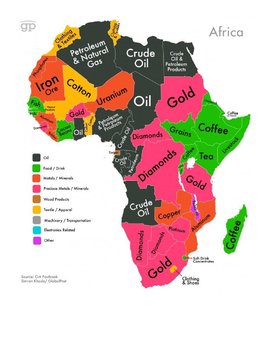
Image Source: https://www.teacherspayteachers.com/Product/Africa-Resource-Mapping-Activity-3902334
Works Cited:
1. Bekele, Daniel. “Africa's Natural Resources: From Curse to a Blessing.” Human Rights Watch, 2 Jan. 2019, www.hrw.org/news/2017/04/21/africas-natural-resources-curse-blessing.
This is an article about possible solutions to the problems caused by resource corruption. It first explains the issues with resource corruption, also adding to the other articles that mining/drilling corporations get favorable treatment from the government in relation to the people b/c the companies are where the power and money comes from. This results in a lack of care for the environment and also entire communities being kicked off their land without any warning. HRW is a reliable source on human rights abuses, but can often over exaggerate, so there might be some bias in that regard.
2. Wantchekon, Leonard. “Why Do Resource Abundant Countries Have Authoritarian Governments? .” Princeton.edu, Princeton University, 15 Oct. 2002, www.princeton.edu/~lwantche/Why_Do_Resource_Dependent_Countries_Have_Authoritarian_Governments.
This is an academic dissertation on the connection between resource dependency and authoritarian governance, mostly concerning African countries, but also using examples outside of Africa to support the overall argument. A statistical connection between these two things is found and explained with the ideas presented in the articles, albeit in more detail and with more supporting evidence. The article comes from princeton university and cites numerous sources. The author’s credibility and biases are unknown, and he could be writing this article in favor of his personal theory rather than the truth.
This article explains the economics behind the ‘resource curse’, or why resource rich countries in africa have slower economic growth than average. Giving specific examples, it talks about how resources enable corruption and conflict, both of which create poverty by wasting public money. CNN, the publisher of this article may be considered biased in western politics, but there is no evident bias in Africa. The author is experienced with writing on Africa and corruption.
4. Hanson, Stephanie. “Corruption in Sub-Saharan Africa.” Council on Foreign Relations, Council on Foreign Relations, 6 Aug. 2009, www.cfr.org/backgrounder/corruption-sub-saharan-africa.
An overview of corruption in sub Saharan Africa by an organization experienced in covering similar topics. It gives a e good overview of the sources (authoritarianism) and consequences of corruption (poverty). It gives examples of how corruption causes conflict in the competition for political power and how it funnels money out of the legitimate economy. There is no reason to believe that this source is biased, outside of a harsher than reality criticism of corruption, which doesn’t seem to be present.

No comments:
Post a Comment
Note: Only a member of this blog may post a comment.