Conflict between the northern and southern halves of Nigeria is so intense that in the three days leading up to the 2011 Nigerian election, violent protests accounted for over 800 deaths and 65,000 people going missing (Agbiboa). This is not uncommon. Nearly everyone in Nigeria has had some experience with the extreme violence and hatred within the country.
The extent of this issue is so intense that Nigeria is the 16th least peaceful country in the world according to the world peace index (Statista). The Nigerian death count averages 8,000 deaths per year from 2011 to 2019 (“Nigerians”) due to political conflict, terrorism, north-south bipolarity, and other forms of hatred and disunity within Nigeria. Why are there such high levels of divisiveness and brutality in Nigeria? Two of the main reasons for the separation and hostility in Nigeria are economic corruption and terrorism.
The first aspect of this issue is that the Christain south of Nigeria dominates the oil industry because the majority of the oil is located on the southern coast (“Nigerians”). This wealth imbalance seems unjust the Muslim north of Nigeria because crude-oil production is by far the predominant source of the country’s revenue (allafrica.com). Despite Nigeria’s prosperity, 60.9% of Nigerians are living in “absolute poverty” according to the National Bureau of Statistics; nearly 100 million Nigerians live on less than USD $1 per day (“Nigerians”)! The reason such poverty is so prevalent even though Nigeria is one of the richest countries in Africa is that the money often falls into corrupt hands. Nigerian foreign exchange rates were a whopping $1.4 billion a month in 2014 (allAfrica.com), but over $300 billion (that’s 18 years worth of production!) cannot be accounted for due to theft and embezzlement (Manila Bulletin). For example, $2.9 billion dollars allegedly dedicated to a terrorism-suppressing military effort directed by Colonial Sambo Dasuki went missing (Global Issues in Context).
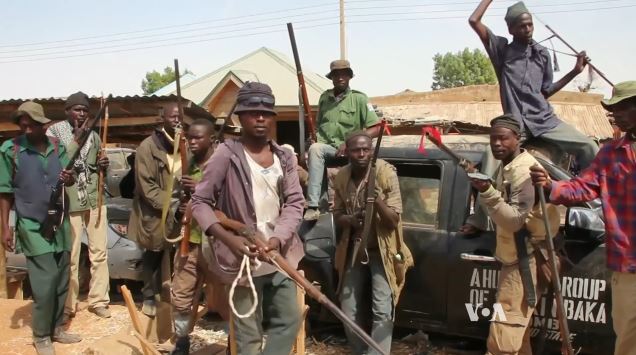
The soaring rates of poverty driven by this economic corruption are 20% higher in the north than they are in the south (“Nigerians”). The conditions in the north are ripe for revolutionary extremist groups to flourish. One such radical group is the Boko Haram. Many impoverished Nigerians in the north feel that such groups are the only providers of safety, shelter and food, so they support these groups despite their use of violent methods such as mass shootings and bombing of oil pipelines (Global Issues in Context). The increased support in these groups only causes the government to focus more energy on putting terrorism down. There is only one problem: similar to how the government abuses the oil industry, they also use corrupt methods to stay in control. It is estimated law enforcement cause more deaths than terrorist groups themselves (New York Times)! This creates a self-feeding cycle. When people in the north see a family member or close friend get killed by governmental forces, they have double the reason to join groups like the Boko Haram.
The people of this region are trapped between violence on both sides. Fortunately, there are efforts to help solve this conflict. For example, newly elected president Buhari is focusing on countering terrorist violence so that the north and south will have to settle their differences in a more peaceful way (New York Times). Also, a Nigerian Tribune journalist advocates for the complete separation of north and south Nigeria into two separate countries to break up the fighting (Nigerian Tribune). Many think Nigerians will continue to live in fear and poverty, but there is hope if the root causes of economic and political corruption can be curbed. As a senior Nigerian advisor puts it, “Either we kill corruption, or corruption kills the country” (PBS NewsHour).
Works Cited:
Agbiboa, Daniel Egiegba. "Serving the few, starving the many: how corruption underdevelops Nigeria and how there is an alternative perspective to corruption cleanups." Africa Today, vol. 58, no. 4, 2012, p. 111+. Global Issues in Context, http://link.galegroup.com/apps/doc/A295172027/GIC?u=los42754&sid=GIC&xid=f07b0f6a. Accessed 14 Mar. 2019.
Campbell, John. “Nigeria Security Tracker.” Council on Foreign Relations, Council on Foreign Relations, 1 Mar. 2019, www.cfr.org/nigeria/nigeria-security-tracker/p29483.
“Countries with the Least Peace Worldwide 2018 | Statistic.” Statista, www.statista.com/statistics/273160/countries-with-the-least-peace-worldwide.
NewsHour, PBS. “Poverty, Corruption Fuel Boko Haram in Nigeria.” PBS, Public Broadcasting Service, 29 Nov. 2015, www.pbs.org/newshour/show/poverty-corruption-fuels-boko-haram-in-nigeria.
"Nigeria." Global Issues in Context Online Collection, Gale, 2019. Global Issues in Context, http://link.galegroup.com/apps/doc/CP3208530126/GIC?u=los42754&sid=GIC&xid=34551066. Accessed 14 Mar. 2019.
“Nigerians Living in Poverty Rise to Nearly 61%.” BBC News, BBC, 13 Feb. 2012, www.bbc.com/news/world-africa-17015873.
"Oil boom, global politics boon to Africa." Manila Bulletin, 30 June 2007. Global Issues in Context, http://link.galegroup.com/apps/doc/A165850577/GIC?u=los42754&sid=GIC&xid=63f4d825. Accessed 12 Mar. 2019.
"The Horrors of Boko Haram." New York Times, 9 Feb. 2016, p. NA(L). Global Issues in Context, http://link.galegroup.com/apps/doc/A442762402/GIC?u=los42754&sid=GIC&xid=4d2a06e0. Accessed 17 Mar. 2019.
"An open letter to 2019 aspirants." Nigerian Tribune [Oyo State, Nigeria], 13 June 2018. Global Issues in Context, http://link.galegroup.com/apps/doc/A542622903/GIC?u=los42754&sid=GIC&xid=1fa55013.

Very nice title- *I see what you did there*. The article is well-written and is very informative with the reader. I can't see any biases or sides taken in the piece; well done.
ReplyDeleteIt really surprised me how many violent protests there are and the casualty statistics knocked me off guard
ReplyDeleteI really like your article - echoing off Evan, it's very well written and I thoroughly enjoyed reading it! I didn't realize that Nigeria was so rich and that there is so much corruption to the point that the country loses 300 billion dollars a month (is that right? or is it in a year because 300 billion a month seems a lot). do you think that there is hope for the country in terms of corruption?
ReplyDeleteReally cool article! I really was shocked at the part where you said "violent protests [were] accounted for over 800 deaths and 65,000 people going missing." That is really scary. You definitely can hook the reader with that statistic.
ReplyDeleteThis article does a great job at explaining this complex issue in depth while still keeping it concise. The main takeaway is that the many background issues are leading to serious problems for civilians and must be addressed. Has this conflict evolved or amplified in recent years and how has the international community responded?
ReplyDelete