Africa’s Great Drain Finally Has a Plug
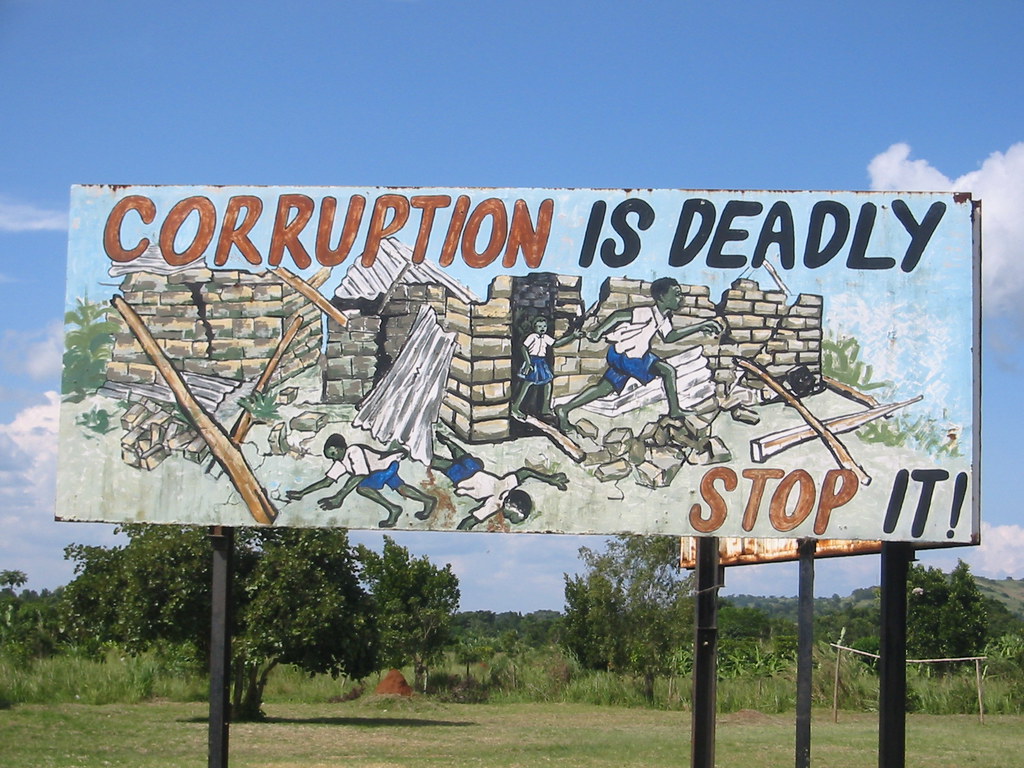 |
| A Civilian-Created Anti-Corruption Sign in Uganda (Photo Credit: FutureAtlas) |
In Sub-Saharan Africa alone, around half of all citizens report paying bribes for property ownerships to prevent their residences from being confiscated by the government (Transparency). In stark contrast to western civilization, where politicians act with a certain standard of moral rectitude, certain politicians in Africa are found to be corrupt to the core. Despite Africa’s many conflicts, perhaps none is as pervasive and deadly as the continent-wide war on corruption. Government corruption is a plague on Africa’s economy and society that has lasted for decades, and still goes unsolved at present date.
But what is the cause of this detrimental and infectious issue? The root of the problem can be traced back to the fact that government officials of Africa in the early 2000s were underpaid due to Africa’s relatively nascent industrialization. Due to general lack of funding for government positions, corruption and money laundering offered a stable alternative to monetary gain (Choruma).
Government corruption in Africa is presently costing its various countries large sums of money every year. According to a study conducted by the Washington Post, the country of Kenya alone suffered a loss of a third of its national budget every year; six billion dollars lost annually to government corruption (Bearak). Bearak states how “The scale of the graft threatens national security, discourages foreign investors and saps public services of funds” (Bearak). Additionally, the African Union estimates around 25% of Africa’s total GDP is lost to corruption; that’s a stunning $150 billion US dollars a year lost to corrupt leaders (Venage). South Africa alone is at present suffocating under a thirty million dollar debt crisis, brought about by corruption at a national level (Deutsche Welle). It is corruption that has caused this massive economic drain; a malignant mentality that has cost the continent billions.
However, a new wave of resistance is rising to fight this corruption; social media and its newest users have made their advent to counter the economic plague of government corruption. With social media apps finally making their advent in Africa’s better-off nations, people finally have the means to communicate and share knowledge of government corruption with officials and with each other. Case in point; technology company BudgIT acts as a provider of cellular service to countless Africans, and to date has assisted in exposing a $113,000 budget funding a non-existent youth center in Nigeria (Akorede). Not only is social media specifically assisting in bringing down corrupt leaders, but entire movements as a whole have united against government corruption. As of May 2018, one hundred and fifty-seven Civil Society Organizations from thirty-seven African nations have banded together to declare war on corruption via a letter to the African Union (Akorede).
Although corruption in Africa has had a persistent history of returns, the new wave of anti-corruption methods in the populace and running politicians may indeed ensure an end to corruption in Africa. A renewed interest in solving corruption as well as a newfound drive for justice could indeed plug Africa’s great economic drain for good.
Works Cited:
Akorede, Shakir. “Here Are Three Ways Africa's Youth Are Defeating Corruption.” World Economic Forum, www.weforum.org/agenda/2018/11/here-are-three-ways-africas-youth-are-defeating-corruption/.
Africa’s youth are fighting back against the wave of corruption through usage of technology, social media, and advocacy groups. All these combined are encouraging people to rise up against corrupt leaders and to take action for themselves and their countries. World Economic Forum is a non-profit organization based in Switzerland; as such, it has nothing to lose by writing an article about the matter and as such, has minimal to no bias. This article showed me the measures that people in Africa take against corruption to stand for their country. It also showed me the importance of a free government for African citizens and the lengths they are willing to go to in order to eliminate corruption.
Bearak, Max. “Kenyans Have Had It with Corruption. Their Leaders May Finally Be Doing Something about It.” The Washington Post, WP Company, 17 July 2018, www.washingtonpost.com/world/africa/kenyans-have-had-it-with-corruption-their-leaders-may-finally-be-doing-something-about-it/2018/07/09/1a895830-7984-11e8-ac4e-421ef7165923_story.html?noredirect=on&utm_term=.d50069edd2cc.
With government corruption finally on the decline, Africa’s leaders have begun to take steps to eliminate corruption in high-end individuals entirely. The article is slightly biased to a more favorable review of the effort given the New York Times’ desire to provide a more beneficial outcome of the new policies. This source gave me information and concrete statistics about the impacts of corruption on a country and the people who live in it.
Choruma, Allen. "Growing menace of corruption in Southern Africa." New African, Nov. 2018, p. 54+. Global Issues in Context, http://link.galegroup.com/apps/doc/A563570843/GIC?u=los42754&sid=GIC&xid=5bcb65a3. Accessed 21 Mar. 2019.
Corruption in Africa is finally being fought against by various international organizations who are pledging to support the cause such as the UNECA and SADC. These organizations are working to spread the knowledge of this corruption and to assist the people in fighting corrupt leaders. This article is credible as it is listed in a literary database, thus being objective. This source showed me measures being taken against corruption and the means that global leaders and groups are taking to tackle this corruption.
e.V. “How to Win the Fight against Corruption in Africa.” Www.transparency.org, www.transparency.org/news/feature/how_to_win_the_fight_against_corruption_in_africa.
Corruption in various African countries is depleting the government of valuable funds and bleeding away at the GDP of these countries. The results on its people and economics are clearly visible and can only improve if corruption is reloved. It is credible as Transparency News works to “provide a more objective standpoint” on modern current events and to present the facts.This source gives me useful statistics on the effects of corruption as well as highlighting why it has to be stopped.
Venage, Gavin du. “Social Media Shines a Light on Corruption in Africa.” The National, The National, 1 Oct. 2018,https://www.thenational.ae/business/technology/social-media-shines-a-light-on-corruption-in-africa-1.775929.
The rise of social media in formerly isolated areas of Africa allows for African citizens across various countries to communicate and notify each other of corruption when they see it and how to solve for it. Anyone with a phone can work directly with the Director of Public Prosecution to expose corruption. The site is not very biased in the article provided as it is from a relatively impartial country on the whole matter, the United Arab Emirates. It is also more of an objective piece rather than an opinion piece, and therefore is less biased. This source is useful to me as it displayed how corruption is being tackled by everyday people in Africa and how new technologies are helping this effort.
“South African Opposition Makes Election Pledge to Fight Corruption | DW | 23.02.2019.” DW.COM, 23 Feb. 2019, www.dw.com/en/south-african-opposition-makes-election-pledge-to-fight-corruption/a-47659446.
New campaigns for upcoming governmental positions are taking an anti-corruption approach. This methodology will allow for corruption to be undone in the government itself, not just through the people. One such political party many seek to undo is the ANC party, long believed to be corrupt. The article is from Deutsche Welle news, a German news site, so it has nothing to gain or lose by reporting on the topic. As such, it takes an objective, informative viewpoint and does not appear to have biases. This article showed me legislative action being taken against corruption and not just activism. It also showed how government leaders themselves are willing to combat this corruption at the presidential level.

My favorite part of your article is the use of statistics to help prove your point. The statement that 25% of Africa's total GDP is lost to corruption was very surprising and helps paint a picture of how bad this problem really is.
ReplyDeleteGood job on the balance of statistics and the paraphrase of information.
ReplyDeleteNice job Evan! My favorite part of the article was in the second paragraph where it said "that’s a stunning $150 billion US dollars a year lost to corrupt leaders." That was absolutely crazy to me. I was pretty stunned.
ReplyDeleteI really like your writing! It was surprising to me that 150 billion dollars would be lost every year to corruption.
ReplyDeleteI enjoyed reading about this topic of corruption, as I think that it is a main reason behind many of these other issues in Africa. Your article was able to take this abstract idea of corruption and illustrate its concrete effects on an entire continent. I am curious as to what motivated you to pick this seemingly broad and abstract idea?
ReplyDeleteVery insightful! You have very strong evidence and I can tell you clearly did a lot of research for this topic. I was shocked to read that 25% of Africa's total GDP is lost to corruption, and this really stood out to me.
ReplyDeleteI liked how it all worked together to make a strong piece. My only question is: are there any other organizations that can help Africa?
ReplyDeleteYour article covers a pretty interesting subject very well. Not only is it supported by statistics, but they're embedded in such a way that it isn't a break in the writing. Good job.
ReplyDelete