


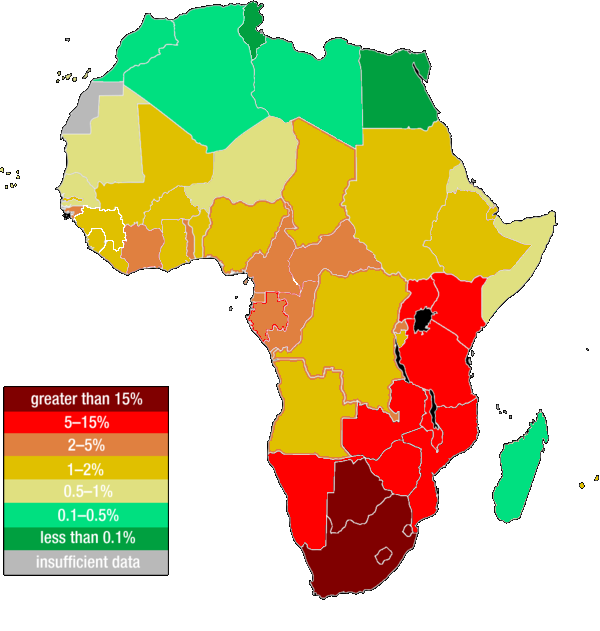
Goliber, Thomas. “The Status of the HIV/AIDS Epidemic in Sub-Saharan Africa.” Population Reference Bureau, 2 July 2002, www.prb.org/thestatusofthehivaidsepidemicinsubsaharanafrica/. This article shed light on the different regions of Africa and how concentrated HIV/AIDS is in Africa compared to the rest of the world. It also mentions the different cultural and religious factors that play a part in the spread of HIV/AIDS. It then goes on to talk about the trends in the fluctuating level of infection throughout Africa. The website is credited with a . org and I looked up the writer, Thomas Goliber on LinkedIn and he has connections with people who have also worked in the field. However since the article is older, the statistics are not very current. This article really compared the different levels of infection in each country and it also discussed why some countries have higher/lower levels. I used it for a statistic in the introduction to give scope into just how severe the issue is.
“HIV and AIDS in East and Southern Africa Regional Overview.” AVERT, 26 Feb. 2019, www.avert.org/professionals/hiv-around-world/sub-saharan-africa/overview. This article goes into detail about the HIV/AIDS epidemic in Africa. It portrays the different demographics that have HIV/AIDS and it also describes the struggles each demographic has. It goes on to discuss the different treatments and also varying levels of government involvement. It is a .org and it cited all the sources where the data came from throughout the article with a footnote. It was also updated on the 26th of February of 2019 which was less than a month ago. However, the website is dedicated to raising awareness about HIV/AIDS and they might play up the disparities in order to receive more attention. This article contained a lot of good statistics that helped to paint a vivid picture through logos. It also gave a detailed description of the types of people who suffer from HIV/AIDS and also a description of the treatment plans and options that are available to them.
Oramasionwu, Christine U., et al. "The Environmental and Social Influences of HIV/AIDS in Sub-Saharan Africa: A Focus on Rural Communities." International Journal of Environmental Research and Public Health, vol. 8, no. 7, 2011, pp. 2967-79. ProQuest, https://search.proquest.com/docview/884401613?accountid=194618. This article talked about the variety of repercussions that HIV/AIDS has in rural communities throughout Africa. They mention environmental effects, family structure shifts, workplace issues, gender dynamic changes, and other effects. I got this article through the database, ProQuest, on the Los Altos High School library webpage. Although they do pose a solution at the end so the information they present would be chosen to frame their solution as the best option. The article focuses on the rural areas of Africa and it hones in on the effects of the epidemic there. This was the source I used in my second main point. I used it to discuss how people who live in rural areas are at a disadvantage, and treatment is not as accessible for them.
Poteat, Tonia, et al. “HIV Prevalence and Behavioral and Psychosocial Factors among Transgender Women and Cisgender Men Who Have Sex with Men in 8 African Countries: A Cross-Sectional Analysis.” PLoS Medicine, vol. 14, no. 11, Nov. 2017, pp. 1–17. EBSCOhost, doi:10.1371/journal.pmed.1002422. This is a write up on a collection of data that details statistics for transgender women, who were born as males, and MSM, men who have sex with men. It compares the two with each other and it discusses why these groups are so disposed to having HIV/AIDS. The conclusion drawn was that transgender women have higher rates of HIV/AIDS along with other things such as depression. Also, a higher percentage of transgender women are victims of rape and abuse. Our school librarian, Mr. Jack, helped me find this source. The study was done by PLOS medicine, and after researching the organization, it became apparent that they are a non-profit with open access to publishing, however, they have weekly reviews on their material. The reviewers would probably catch most mistakes and wrong information, but it is still an open-access source. Also, since there is a scant amount of data on HIV/AIDS within the transgender community, there is not much to check this data with. This source helped to give insight into the status of HIV/AIDS in the LGBTQ+ community. It also provided data on the subject along with some possible next steps. I used this source to give a statistic on how many of the total people worldwide who have HIV/AIDS live in Africa.
Unaids.org. “‘The Community Is Not on the Girls' Side.’” UNAIDS, UNAIDS, 20 Mar. 2019, www.unaids.org/en/resources/presscentre/featurestories/2019/march/20190318_riseclubs. Their purpose is to help young women learn more about their sexuality and inherent human rights, and as a result, the conversation about sex and HIV/AIDS becomes less stigmatized. Also, young women are given a safe place to have hard discussions that they would not otherwise have. This is a recent article published in March of 2019. It was published by UNAIDS which branches off from the United Nations, and its purpose is to help alleviate the worldwide pandemic, HIV/AIDS. However, they might exaggerate progress to make it seem like the problem has been solved more than it actually has. This article focuses on young women in Africa and specifically why such a high percentage of people in Africa with HIV/AIDS are young women. It also talks about the solutions they have been using to fix the issue. I used this article in my first main point where I describe the struggles that young women face with HIV/AIDS.
Unaids.org. “An Historic Opportunity to End AIDS in Africa.” UNAIDS, UNAIDS, 3 May 2018, www.unaids.org/en/resources/presscentre/featurestories/2018/april/turning-point-for-africa. This article is describing how the future for prevention of HIV/AIDS is looking up. The UN has not only done better than their original plans, but the trends are also projected to continue to do better. Many countries are involved and they are inspired by the tremendous progress in sub-Saharan Africa. The UN is a highly respected organization that many countries are a part of. Also, they would hold their own progress in higher acclaim and they would put more favorable lighting on themselves. However their purpose is to seek out problems and fix them, so they do not gain very much from covering up a global issue. This gave a good perspective on what the predictions are for HIV/AIDS in the upcoming future. It also helped to show how recent statistics help to support the projections. This article was helpful in my background because it gave a good historical scope of the issue.

I really enjoyed your word choice, which made your writing more interesting. It was quite surprising to see the statistics of HIV and the significant impacts that it has of the people in Sub-Saharan Africa.
ReplyDeleteYou did a good job blending your statistics into your writing and it contributed to a nice flow.
ReplyDeleteI found it very interesting and insightful that you included the viewpoint of adolescent girls in your article, and how the society is also helping perpetuate the virus; it made your article more complex and original.
ReplyDelete